
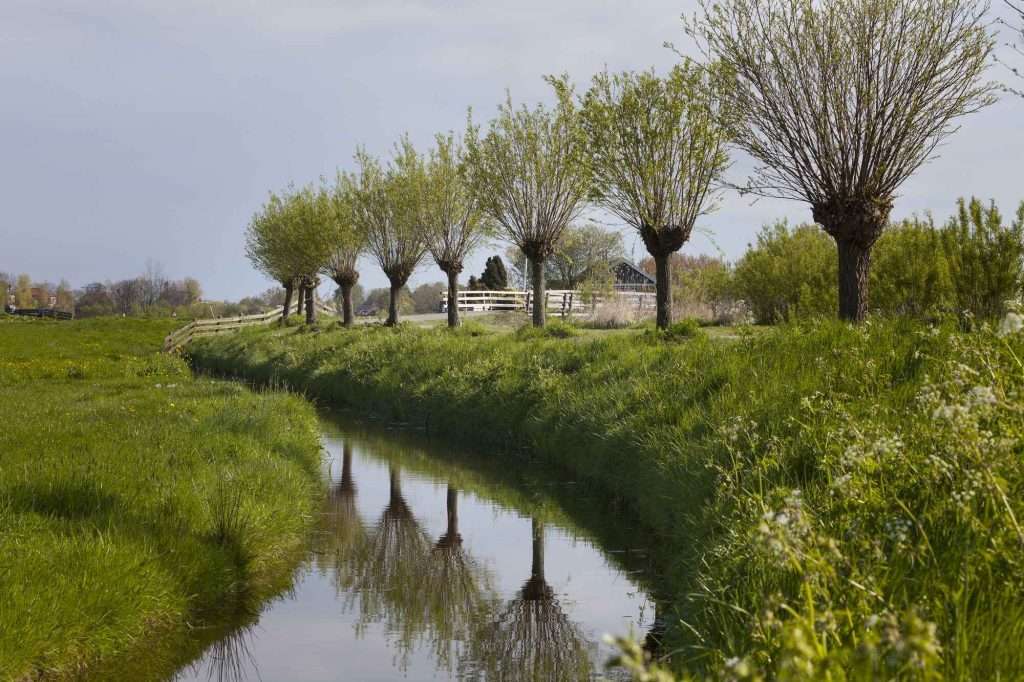
Pollarding in Surrey
Pollarding keeps a tree to a fixed size by cutting its new growth back to the same points every few years. Over time the tree forms rounded knuckles at the ends of its main branches, and fresh shoots grow from them each season. It is a traditional technique, and you will see it on willows by rivers and on lime and plane trees along streets.
Which trees can be pollarded
Pollarding suits species that grow back strongly after cutting, including:
- Willow
- Lime
- London plane
- Ash, oak and sycamore, when the pollard is started young
- Mulberry, hornbeam and some fruit trees
It does not suit every tree. Species such as beech and birch respond poorly to heavy cutting, and a mature tree that has never been pollarded cannot simply be cut back hard without risking decay or killing it.
Starting a new pollard
A pollard is best started on a young tree. We cut the main stem or branches at the height you want the framework to sit, and the tree sends out new shoots from just below the cuts. Those shoots are then cut back to the same points on a regular cycle, every one to five years or so depending on the species and the look you want.
Keeping up an existing pollard
Regular pollards are straightforward to maintain. We remove the regrowth back to the knuckles without cutting into them, as the knuckles are where the tree's defences against decay are strongest.
Restoring a lapsed pollard
Pollards that have not been cut for many years grow large, heavy branches from the old knuckles, which can split away. Bringing them back is done carefully, often over several visits a few years apart, so the tree is not shocked by losing too much at once. We assess the tree first and tell you whether restoration is realistic.
Timing and protected trees
Pollarding is usually done in late winter or early spring, while the tree is dormant. Between March and August we check for nesting birds before any work. Trees with a Tree Preservation Order need council consent before they are pollarded, and most work on trees in a conservation area needs six weeks' notice to the council. All our work follows BS3998, the British Standard for tree work.
Frequently asked questions
Is pollarding the same as topping?
No. Pollarding is a planned system started on a young tree and kept up on a cycle. Topping cuts a mature tree off at an arbitrary height, which damages it and leads to weak regrowth.
How often does a pollard need cutting?
Every one to five years for most trees, depending on the species and how much regrowth you are happy to see.
Can you pollard my large, mature tree?
Usually not in one go. If it has never been pollarded, crown reduction is normally the better way to bring it down in size.
Can any tree be pollarded?
No. Willow, lime, plane and some others respond well, but many species do not regrow from heavy cuts and would decline. We will tell you whether your tree is suitable.
Licensed and insured
-
 City & Guilds NPTC qualified
-
 Arborisk public liability insurance
-
 CHAS accredited contractor
-
 BS3998 tree work
What people say about us
-
Hats off to these guys
Exceptional service! The task was executed with utmost precision and quality. Totally recommend these folks!
Josh
-
Lumberjack legends
Absolutely stellar service that nailed it according to our exact wishes from this pro crew. Already planning to hit them up again soon.
Carl
-
Aced the tree felling
Absolutely thrilled with the tree felling service provided by Christian and the team! Precision and expertise were on full display as they brought down the giants in my yard.
Ryan
Get your free quote today
Speak to a member of our team on 07488 892213